

We will discuss how female drivers have progressed recently, especially with the F1 Academy and former W Series. Due to limited data, we’ll use young male athlete data to make the most accurate comparisons currently possible for the female driver landscape in 2026.
Most training companies lack enough data to claim one training form is better for females versus males. However, we will analyze major physiological differences in depth to provide reasoned conclusions and recommendations for elite driver development.
We’ll explore physiological sex differences, theoretical performance standards, and current training philosophies. We also examine attitudes in motorsports and why gender-based series may not be needed to produce the best professional race drivers.
Physiological Differences Between The Sexes
The phrase we hear in professional motorsports is that “women are not strong enough.” This is a loaded statement based on limited experience and data that is often manipulated or incorrect. We must look at examples of women competing globally for a fairer analysis.
Danica Patrick told For The Win,
I think that the natural stature of a man versus a woman is probably what’s deceiving because men are naturally – stature wise, strength, muscle mass – they are stronger. When you take the peak strength of a man or a woman in the world, they’re going to be different. But in racing, we’re not dealing with peak strength. We’re dealing with endurance.
We’re dealing with strength but mostly endurance of that, so that’s not necessary. The level of strength that you need is achievable across the board, so obviously that’s just not true. And much of (success), too, comes from being relaxed behind the wheel and getting the car to handle for you, and then things also get a lot easier.
What Danica alludes to is quite correct. Performing resistance training within the 8-12 repetition range for “driver strength” is where exercises typically need to be performed. This is seen in training programs from Ayrton Senna’s time, when training programmes started to become understood from a scientific perspective.
Drivers like Simona de Silvestro and Katherine Legge share the approach Danica Patrick alludes to. All three are successful, proving that strength is not the limiting factor in open-wheel or closed-cockpit racing.
The Biological Ceiling
Men possess larger lungs and greater lung diffusion capacity. Consequently, a woman’s maximal exercise capacity (VO₂ Max) may be relatively limited by pulmonary capacity and lower hemoglobin content (from another of my Flow Racers articles).
Adapting a cardiovascular program for a female driver helps address these factors. While it won’t remove biological differences, it can compensate for limits and improve the key variables that are lower biologically in women.
Physiological testing should focus on lactate threshold, as it is a better parameter for understanding how long an athlete can sustain a stint of maximum effort compared to just measuring VO₂ Max.
Benchmarking Performance Standards
To understand where female drivers stand, we must look at established male benchmarks. A key study by McKnight et al. (2019) of 18 male drivers provides the current industry standard for elite performance across various global racing series.
| Series | VO₂ Max (mL/kg/min) | Body Fat (%) |
| F1 | 62.0 ± 6.0 | 8.1 ± 1.7 |
| IndyCar | 58.05 ± 6.40 | 17.4 ± 1.7 |
| NASCAR | 53.2 ± 4.1 | 17.3 ± 4.6 |
| IMSA GTD | 45.2 ± 2.1 | 24.9 ± 1.8 |
The significant problem remains: no equivalent female data exists in published research. Without female-specific studies, we are forced to use theoretical extrapolations to set targets for women entering these professional tiers.
Theoretical Female VO₂ Max Targets
Applying a 10-12% adjustment to male benchmarks isn’t a “downgrade” in performance. Instead, it’s an adjusted figure reflecting that women often possess a higher relative lactate threshold, allowing them to operate closer to their biological ceiling for the entire race.
While a male driver might have a larger “engine” (VO₂ Max), a female driver can often sustain a higher intensity without redlining. These theoretical targets provide a baseline, but the goal is to maximize the percentage of oxygen used during a full race stint.
These figures are educated guesses, as no one has formally validated these scales for female motorsport athletes. With correctly prescribed training, female drivers can push these parameters, but we require more longitudinal research to confirm these windows accurately.
| Series | Male VO₂ Max | Theoretical Female VO₂ Max |
| F1 | 62.0 | ~55-56 |
| IndyCar | 58.05 | ~51-52 |
| NASCAR | 53.2 | ~47-48 |
| IMSA GTD | 45.2 | ~40-41 |
While these figures provide a working baseline, they are not absolute limits. With correctly prescribed training, female drivers can push these parameters, but we require more longitudinal research to confirm these performance windows accurately.
Standards for Young Female Drivers
Many drivers start as teenagers, making adult comparisons unfair. According to NHANES data (Eisenmann et al., 2011), a 16-year-old girl at 44-45 mL/kg/min is already in the 75th-90th percentile for her age, well above the trained athlete mean of ~41.
| Percentile | VO₂ Max (Age 16 Female) |
| 95th | 52.0 |
| 90th | 48.3 |
| 75th | 42.9 |
| 50th | 37.8 |
Young athletes improve quickly; studies show meaningful VO₂ Max gains in just 6 weeks of training (Henríquez-Olguín et al., 2022). This rapid adaptation allows young female drivers to surpass average athletic norms as they prepare for higher categories.
The Performance Lever: Why Lactate Threshold Trumps VO₂ Max
While men often have a higher “ceiling” (VO₂ Max), research suggests women possess a higher relative lactate threshold. This means a female driver can often sustain a higher percentage of her maximum capacity for longer periods without hitting the metabolic “wall.”
This is the true “performance lever.” If we think of VO₂ as the engine of an F1 car and lactate threshold as the gearing, the threshold is what female drivers can affect in a much greater way. It allows the athlete to sustain harder effort for a much longer duration.
To illustrate, a male driver with an absolute VO₂ Max of 65 might only sustain 80% of that for an hour. A female driver with a VO₂ Max of 56 who sustains 88% of her max for the same duration effectively closes the performance gap through superior efficiency.
Women often have a higher proportion of Type I muscle fibers, aiding fat oxidation. Because they utilize fuel more effectively, they can produce less lactate at sub-maximal intensities, pushing the threshold closer to their VO₂ Max than their male counterparts.
Pushing the lactate threshold makes the athlete better aerobically for longer before the anaerobic system is required. It is arguably a better decision for coaches to prioritize this “gearing” over simply trying to increase the overall size of the engine.
Crucial lap times relate to training at or near the individual’s lactate threshold. While female athletes will be racing at a higher percentage of their VO₂ Max, this metabolic efficiency is the assumption observed by elite coaches working on the ground today.
While limited formal research makes this an assumption, it remains a core phenomenon observed by elite coaches working specifically with female racing drivers.
The Data Deficit: Moving Beyond Theoretical Benchmarks
The theoretical 10-12% VO₂ Max performance standard adjustment for women often comes from a study on sex differences by Hunter et al 2024. This research highlights significant male advantages in performance due to hormonal and physiological factors.
Another study on VO₂ Max and endurance noted female marathon records improved three times faster than males between 1985 and 2004. Despite this, a ~10–12% gap remains in distance running world records, even as athletes reach once unattainable results.
Even today, women are significantly underrepresented in sports performance research. While correct training allows female drivers to push all parameters, more longitudinal research into female motorsport performance across all race series is urgently required.
Drivers should receive an assessment of personal strengths and weaknesses regardless of gender. However, studies show we must understand how to fit biological considerations into a periodised training programme specifically tailored for a female racing driver.
Elite athlete Simona de Silvestro transitioned from IndyCar and F1 testing to Olympic Bobsleigh. She accomplished this by adjusting training programmes to tap into power and fast-twitch muscle development, moving away from the endurance-based focus used in motorsports.
Simona has beaten males in IndyCar and competed in the Indy 500. While she is an elite outlier, her success proves that women can compete at the highest level by optimizing specific physical traits required for different motorsport disciplines.
Training Strategies to Increase Lactate Threshold
To increase the lactate threshold, one of the best strategies is interval work. This can be done via running, cycling, or rowing. Higher intensity intervals interspersed with lower intensity recovery periods help the body improve tolerance to high lactate levels.
Pushing for 3 minutes at the lactate threshold followed by 2 minutes of recovery enables the “push element” of performance. This is vital during a race when fatigue limits concentration, such as during an intense stint at the 24 Hours of Daytona or Le Mans.
A Sample Workout to Boost Lactate Threshold
Try this sample lactate workout on a bike:
- Commit to a 20- to 30-minute total session on a road or gym bike.
- Start with a steady warm-up to prepare your cardiovascular system.
- Perform intervals of 3 minutes at max effort to push your limits.
- Follow each push with 2 minutes of steady recovery to lower your heart rate.
- Build high-level fitness by working up to this intensity carefully to avoid overexertion.
How to Find Your Lactate Threshold Heart Rate (LTHR)
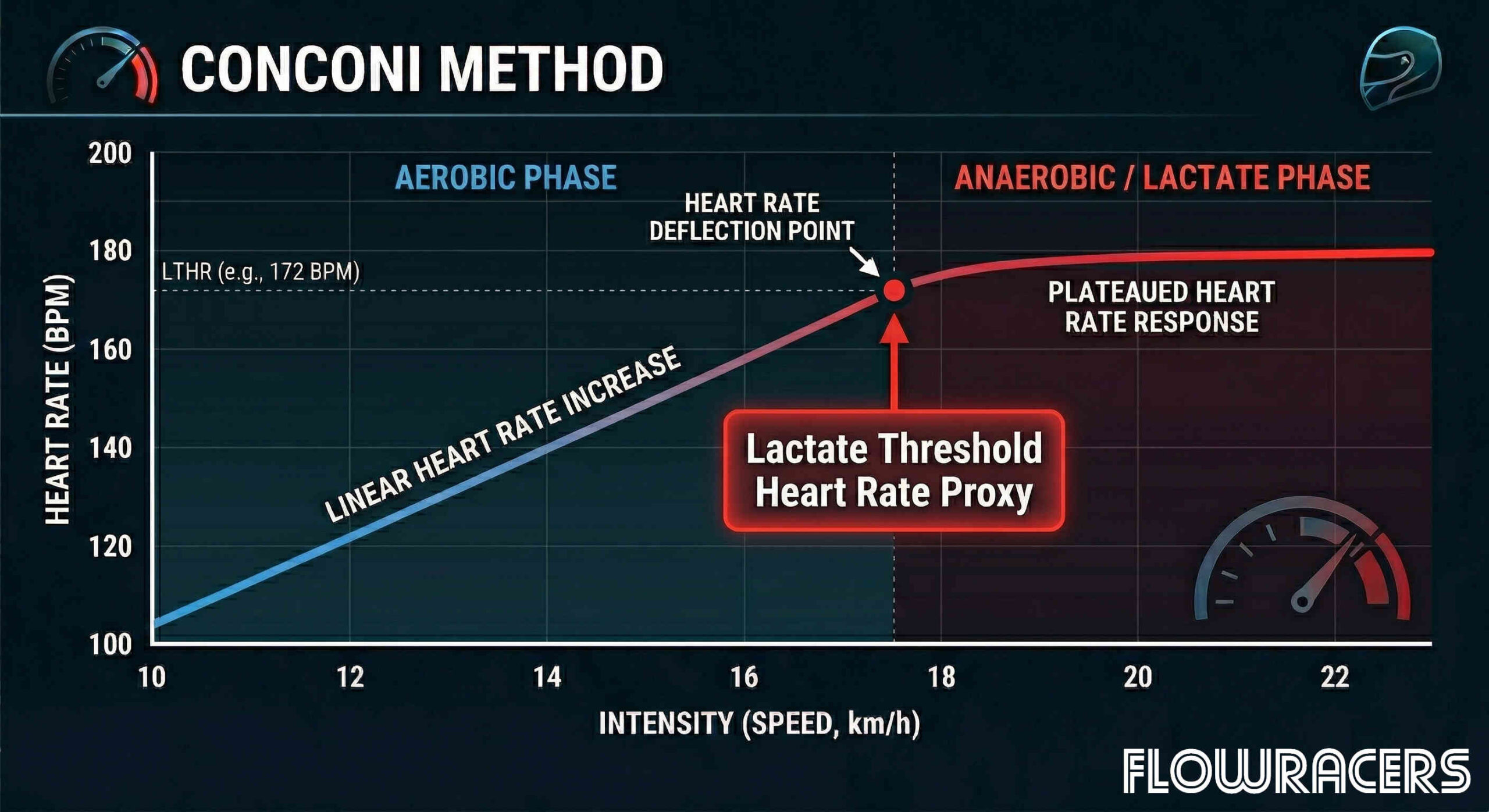
You can perform a lactate threshold test using a heart monitor. Increase intensity every minute for 20 minutes until heart rate increases plateau. This indicates the point where lactate can no longer be cleared, allowing you to set an accurate training regimen.
While a lab test using blood is the gold standard, a heart rate monitor provides a Lactate Threshold Heart Rate (LTHR) proxy. This isn’t your max heart rate; it’s the highest sustainable effort before your body transitions from aerobic to anaerobic metabolism.
The test relies on the Conconi Method, where heart rate and intensity correlate linearly until a “deflection point.” This plateau indicates your metabolic limit, showing the exact heart rate where lactate begins to accumulate faster than it can be cleared.
While the Conconi Method is a widely used field test, it has mixed reviews in academic research. Critics note that a clear heart rate deflection point is not visible in every athlete, and fatigue can skew results. However, it remains a valuable non-invasive proxy for training.
To find your functional threshold at the gym:
- Wear a heart rate monitor to track real-time data throughout the test.
- After a warm-up, increase intensity every minute for a 20-minute period.
- Identify the heart rate plateau where BPM stops rising despite more effort.
- This “deflection point” marks your specific LTHR value.
- Use this BPM to set training zones for maintaining a consistent race pace.
The Reality: Drivers Aren’t Just Sitting There
Data shows drivers face extreme stress. Heart rates hit 80-90% max for extended periods (Brearley & Finn, 2007). Cockpit temperatures can exceed 50°C, while drivers endure up to 5G through corners and high sweat rates of 0.6-1.2 L/hr.
Aerobic fitness genuinely matters for heat tolerance and cognitive function. Building a high lactate threshold ensures the driver does not fall apart in the final stint, maintaining the physical and mental intensity required to stay competitive until the finish.
Current Training Philosophies
Much has been written about professional driver training and physiological testing. This section focuses on modern training philosophies, evaluating their merit and the scientific basis for their inclusion in a driver’s elite regimen.
Advanced platforms like Dynisma have transformed simulators from games into professional training tools. These are now integrated into training circuits, allowing drivers to bridge the gap between physical conditioning and cockpit-specific skills.
Some programs isolate specific muscles using resistance machines, while others focus on compound movements like cleans and squats. These multi-joint exercises are highly effective for female drivers to activate greater muscle contraction velocity.
Compound lifts performed in the 8-12 rep range promote the release of key hormones such as Human Growth Hormone and Insulin (Health Council Canada). This hormonal response is vital for muscle adaptation and recovery (PMC7927075).
Organizations like More Than Equal aim to be “data-driven.” However, current efforts often focus more on data collection than analysis, frequently led by university physiologists rather than experienced track-side fitness trainers.
To produce peer-reviewed results, researchers must use Analysis of Variance (ANOVA). This measures differences between males, females, and control groups to determine if gender-specific programming is actually required for future success.
Ultimately, training must address the specifics of the race series and the individual. The goal is to build the “best” professional driver by focusing on personal strengths and weaknesses rather than a generic gender-based template.
Attitudes to Women in Motorsports
Attitudes in motorsports have improved since the launch of F1 Academy in 2023. However, women are often still viewed through a marketing lens rather than a performance one. This debate mirrors the male market regarding who truly qualifies as an exceptional driver.
In 2026, we see rising talent in Formula 4 and drivers like Doriane Pin, the Mercedes F1 Development driver. These standouts are shifting the focus from PR appeal to on-track results, proving that female performance is reaching new, competitive heights.
The core mission should be identifying the best racing drivers regardless of gender. Beyond the cockpit, we must also open global opportunities for women in diverse professional roles across the entire motorsport ecosystem, not just behind the wheel.
From a coaching perspective, the focus must be on off-track development. By tracking physical, nutritional, and mental data, coaches can demonstrate how female drivers measure up against male benchmarks over the long term using objective metrics.
Analysis of Gender-Based Race Series (Why They Aren’t Required)
Is the place that F1 Academy and gender-specific programs like Formula Woman currently fill helpful? While More Than Equal provides a gender-specific program, racing drivers are not footballers; it is a unique sport where the individual must be the main consideration.
This is where we disagree with The More Than Equal philosophy. Our coaches have vast experience training both male and female motorsports athletes and know that the individual perspective is paramount, regardless of the gender-driven training models often proposed.
In fact, why is F1 Academy not open to both genders, making another F4 feeder series available to the best talented racing drivers? This setup would allow talent to be fostered irrespective of gender, ensuring the most capable athletes receive the support they need.
Conclusions and Recommendations
Major physiological differences between sexes must be reflected in any formalized training. However, factors like stroke volume and hemoglobin content can be addressed through correctly applied individual programs tailored to the driver’s specific biological needs.
While group programs for young female drivers have an effect, individualization is what turns talent into success. Over the long term, focusing on the athlete’s personal strengths rather than a gender-driven template is what builds a professional career.
The key takeaway remains that Lactate Threshold is the primary lever for performance. While VO₂ Max provides the engine size, the ability to sustain effort near the threshold is what allows a female driver to compete at the highest level despite biological differences.
The Bottom Line
To compare female drivers to male benchmarks with an open mind, you must:
- Apply a 10-12% adjustment for sex differences based on current limited data.
- Utilize age-appropriate norms for young, developing athletes.
- Acknowledge these are theoretical extrapolations until motorsport-specific studies exist.
- Conduct research with larger test groups using ANOVA (analysis of variance) testing.
What’s Missing from the Research
- Any published VO₂ Max data specifically for female racing drivers.
- Validation that the 10-12% adjustment holds in motorsport-specific contexts.
- Longitudinal data tracking female driver development throughout their careers.
By addressing these gaps, we can move away from assumptions and toward a scientifically validated framework for elite female performance.
Simon has over 20 years of experience training elite racing drivers across series such as Formula 1, NASCAR, IndyCar and Le Mans. With clients including multiple championship winners, he shares his teachings at Flow Racers to help more drivers reach the highest ranks.